RED-ACT Report for Jan. 25, Japan Nagano-ken Nambu Earthquake
RED-ACT Report
Real-time Earthquake Damage Assessment using City-scale Time-history analysis
Jan. 25, Japan Nagano-ken Nambu Earthquake
Research group of Xinzheng Lu at Tsinghua University
First reported at 22:40, Jan. 25, 2019 (Beijing Time, UTC +8)
Acknowledgments and Disclaimer
The authors are grateful for the data provided by K-NET and KiK-net.
This analysis is for research only. The actual damage resulting from the earthquake should be determined according to the site investigation.
1. Introduction to the earthquake event
At 21: 10, Jan. 25, 2019 (Local Time, UTC +9), an M 3.4 (JMA) earthquake occurred in Nagano-ken Nambu, Japan. The epicenter was located at 36.0N, 137.6E, with a depth of 10.0 km.
2. Recorded ground motions
Ten ground motions near to epicenter of this earthquake were analyzed. The maximal recorded peak ground acceleration (PGA) is 87cm/s/s.
No. Station Name Longitude Latitude
1 GIF003 137.301 36.3322
2 GIF004 137.517 36.2492
3 GIF007 137.486 36.0378
4 GIF008 137.26 35.9515
5 GIF010 137.245 35.8029
6 NGN013 137.785 36.1833
7 NGN017 137.826 35.9748
8 NGN018 137.53 35.8132
9 NGN019 137.708 35.8562
10 NGN022 137.613 35.6079
3. Seismic damage analysis for target region subjected to the recorded ground motions
Using the real-time ground motions obtained from the strong motion networks and the city-scale nonlinear time-history analysis (see the Appendix of this report), the damage ratios of buildings located in different places can be obtained. These damage ratios can provide a reference for post-earthquake rescue work. The damage ratio distribution of the buildings near to different stations is shown in Figure 1. The human comfortableness distribution near to different stations is shown in Figure 2.
The details can be accessed at
http://www.luxinzheng.net/software/2019-01-25-Japan-3.4.html
http://www.luxinzheng.net/software/2019-01-25-Japan-3.4-Acc.html
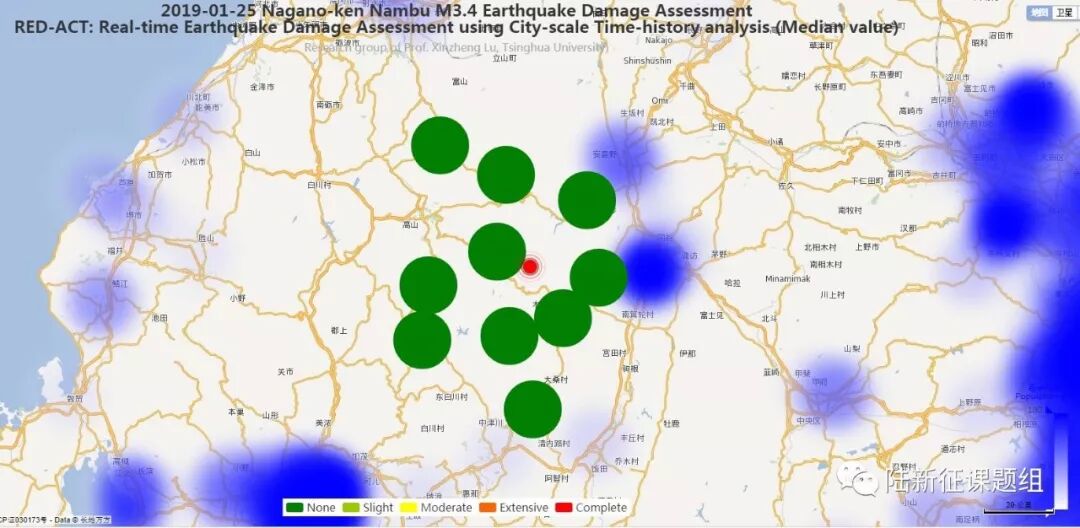
Figure 1 Damage ratio distribution of the buildings near to different stations
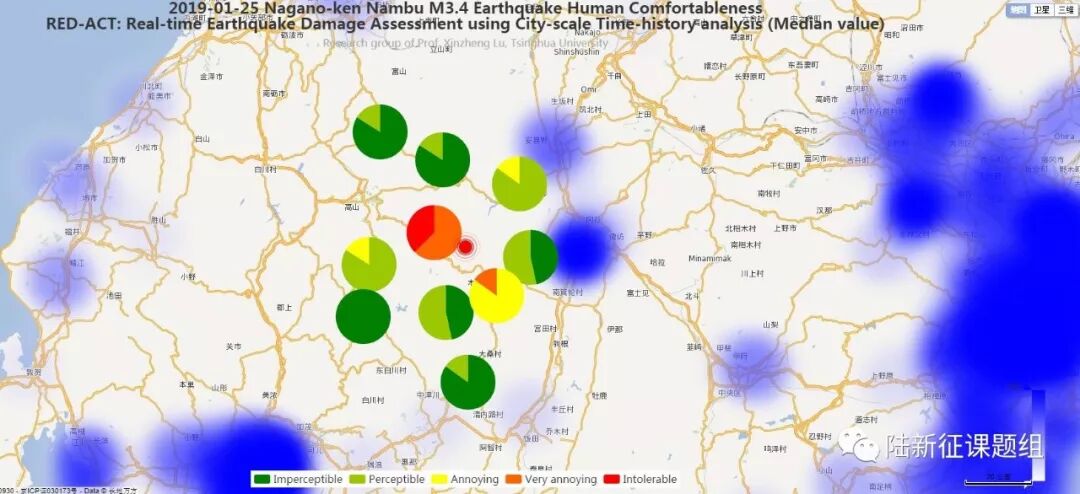
Figure 2 Human comfortableness distribution near to different stations
---------End--------
相关研究
长按识别二维码,关注我们的科研动态